Press release | 28 October 2026
Ten awards recognise outstanding achievements in space research, education, industry, public engagement and international collaboration at the 21st Sir Arthur Clarke Awards ceremony in London.
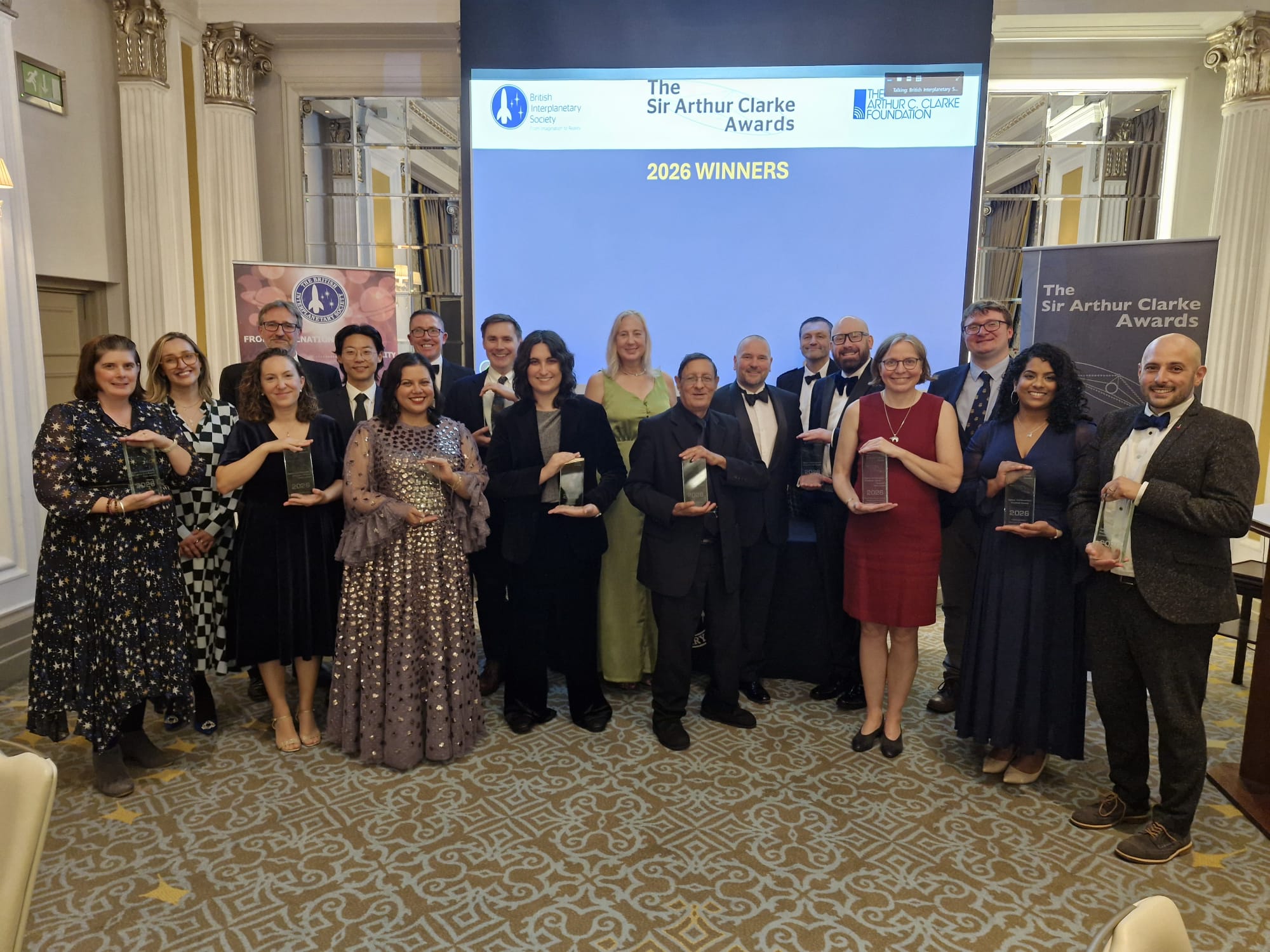
The 2026 Sir Arthur Clarke Awards celebrated outstanding achievements across the space sector at a ceremony held at the RAF Club in London on Tuesday 27 October. Hosted by science presenter Dallas Campbell, the 21st annual ceremony recognised individuals, teams and organisations making significant contributions to space research, education and outreach, industry, media and international cooperation.
Presented by the Arthur C. Clarke Foundation, with the British Interplanetary Society, the awards attracted 69 nominations across ten categories. A panel of 51 judges took part in two rounds of voting to determine this year’s winners.
Founded in 2005, with the first ceremony held at Charterhouse School, the Sir Arthur Clarke Awards recognise achievement across the UK space sector and beyond, celebrating contributions that advance space science, inspire new generations and strengthen international collaboration.
Opening the ceremony, host Dallas Campbell reflected on Arthur C. Clarke’s enduring spirit of exploration, quoting his words: “The only way of discovering the limits of the possible is to venture a little way past them into the impossible.”
The sentiment set the tone for an evening celebrating the people and organisations pushing the boundaries of what is possible in space.
The 2026 Sir Arthur Clarke Award winners
This year’s ten awards recognised achievements spanning planetary science, space instrumentation, inclusive outreach, satellite technology, public engagement and international space operations.
Academic Study/Research – Individual
Winner: Dr James O’Donoghue
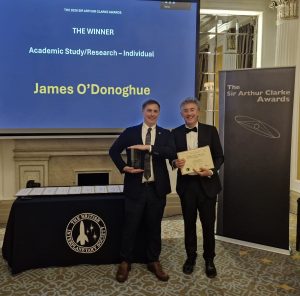
Dr James O’Donoghue received the award for advancing frontier planetary science while making an exceptional contribution to public understanding at scale.
Academic Study/Research – Team
Winner: Imperial College London – Comet Interceptor FGM-B2 Magnetometer Team
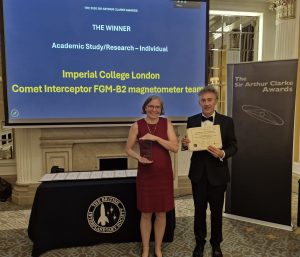
The team was recognised for the design and build of the magnetometer for the European Space Agency’s Comet Interceptor mission.
Education and Outreach – Individual
Winner: Anushka Sharma
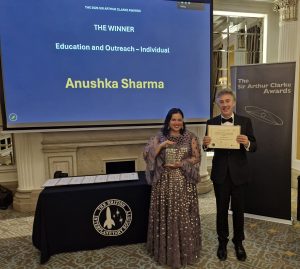
Anushka Sharma was honoured for outstanding leadership in building inclusive UK space communities and bridging academic outreach with industry.
Education and Outreach – Team
Winner: The National Space Centre, Leicester
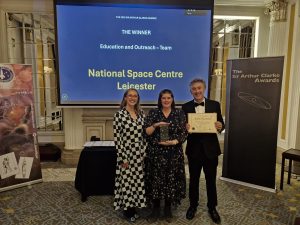
The National Space Centre was recognised for delivering structured learning experiences on-site, online and in communities across the UK.
Industry/Project – Individual
Winner: Sara Alão
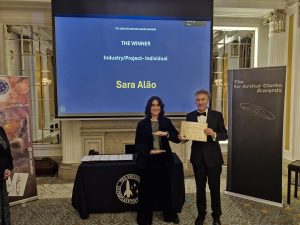
Sara Alão received the award for bootstrapping Stars Edge to a patented very low Earth orbit (VLEO) propulsion system and its first launch slot.
Industry/Project – Team
Winner: Surrey Satellite Technology Ltd – HydroGNSS Team
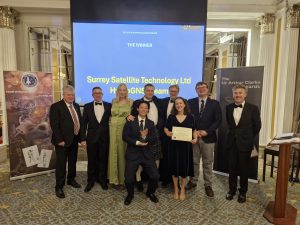
The HydroGNSS Team was recognised for the successful first mission in the European Space Agency’s new Scout class, involving twin HydroGNSS satellites launched aboard a SpaceX Falcon 9 rocket from Vandenberg in November 2025.
Using Global Navigation Satellite System (GNSS) reflectometry, the satellites measure variations in reflected signals to map moisture, ice and flooding with extreme precision.
Lifetime Achievement
Winner: Jerry Stone
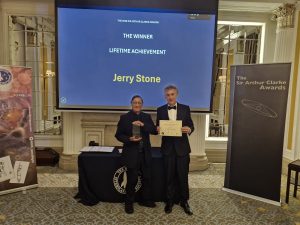
Jerry Stone received the Lifetime Achievement Award for a remarkable career promoting astronomy and space exploration through public engagement, education, writing and broadcasting.
Media, Broadcast and Written
Winner: Kaya Burgess
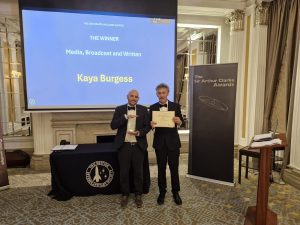
Kaya Burgess was recognised for comprehensive, engaging and accessible media coverage across all fields of space exploration and science.
Space Achievement by a Student -Team
Winner: Croydon High School Astrogazers / Mission Pegasus
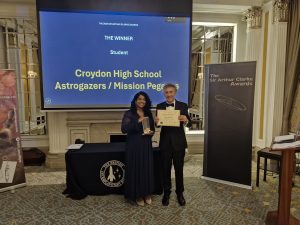
The student team was honoured for inspiring girls through a pioneering satellite project combining technical ambition, teamwork and public engagement.
International Achievement
Winner: Joint Commercial Operations (JCO) Team
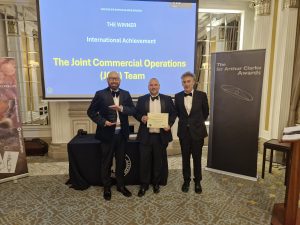
The Joint Commercial Operations Team received the award for pioneering the integration of commercial space capabilities into multinational operations, strengthening space domain awareness, allied interoperability and international collaboration.
Recognising the breadth of the space sector
The 2026 winners demonstrate the breadth of achievement celebrated by the Sir Arthur Clarke Awards, from fundamental scientific research and the development of space instrumentation to satellite missions, education, public engagement and international cooperation.
The awards also highlight the importance of making space accessible to wider audiences. Alongside technical and scientific advances, this year’s winners include those building inclusive communities, delivering learning opportunities across the UK, communicating discoveries through the media and inspiring the next generation of space professionals.
With recognition spanning individual contributions, collaborative teams and student achievement, the ceremony celebrated the diverse expertise and commitment that continue to advance the UK’s space sector and its international partnerships.
Celebrating 21 years of achievement
Since their foundation in 2005, the Sir Arthur Clarke Awards have provided a platform for recognising outstanding contributions to space across research, education, industry, media and international achievement.
The 2026 ceremony brought together this year’s finalists and winners to celebrate their accomplishments and the wider community working to advance space exploration and understanding.
Following the presentation of the ten awards, Colin Philp, President of the British Interplanetary Society, was invited to deliver closing remarks. The evening concluded with photographs of the winners and finalists.
The Arthur C. Clarke Foundation and the British Interplanetary Society congratulate all ten winners and thank the finalists, judges and everyone who contributed to the 2026 Sir Arthur Clarke Awards.
ENDS
About the Sir Arthur Clarke Awards
The Sir Arthur Clarke Awards celebrate outstanding achievements in space across the UK and internationally, recognising contributions in academic study and research, education and outreach, industry and projects, lifetime achievement, media, student achievement and international collaboration.
Presented by the Arthur C. Clarke Foundation with the British Interplanetary Society, the awards were first held in 2005 at Charterhouse School. The 2026 ceremony marked the 21st annual event.
2026 winners at a glance
Academic Study/Research – Individual: Dr James O’Donoghue
Academic Study/Research – Team: Imperial College London – Comet Interceptor FGM-B2 Magnetometer Team
Education and Outreach – Individual: Anushka Sharma
Education and Outreach – Team: The National Space Centre, Leicester
Industry/Project – Individual: Sara Alão
Industry/Project – Team: Surrey Satellite Technology Ltd – HydroGNSS Team
Lifetime Achievement: Jerry Stone
Media, Broadcast and Written: Kaya Burgess
Space Achievement by a Student Team: Croydon High School Astrogazers / Mission Pegasus
International Achievement: Joint Commercial Operations (JCO) Team