
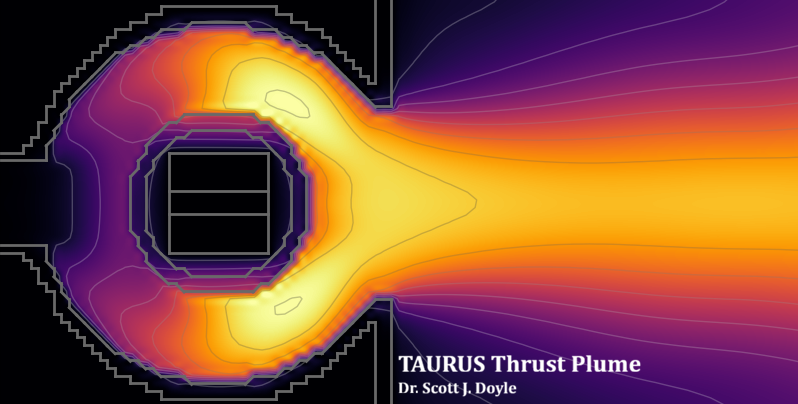
Electric and plasma propulsion have become central to contemporary deep‑space and Earth‑orbit missions, but most systems are still optimised for narrowly defined operating conditions and mission profiles. Dr Scott Doyle’s talk explores how we can “optimise for adaptability” when designing next‑generation plasma propulsion systems, enabling spacecraft to respond more flexibly to changing power levels, mission timelines and operational constraints.
Our speaker will present current research originally developed for the recent Europhysics Conference on Atomic and Molecular Physics of Ionized Gases (ESCAMPIG) on the design and modelling of adaptable plasma thrusters. The presentation will examine how key design choices (discharge configuration, propellant utilisation, magnetic topology, control strategies and thermal management) affect the ability of a system to operate efficiently over a wide range of thrust and specific impulse and to remain robust under off‑nominal conditions.
Using examples drawn from high‑power electric propulsion missions such as BepiColombo, the talk will discuss:
-
Design trade‑offs between peak performance and operational flexibility
-
Strategies for extending the useful operating envelope of plasma thrusters
-
Handling long‑duration operation, degradation and plume–spacecraft interactions
-
Implications for future science and exploration missions requiring adaptable propulsion
Members and guests with an interest in advanced propulsion techniques, plasma physics and spacecraft systems engineering will be particularly interested. There will be ample time for questions and discussion following the main talk.
Speaker bio: Dr Scott J. Doyle is an Assistant Professor and Head of the Plasma Science Research Group at the University of Aberdeen, and Collaborative R&D Lead at Oxford Instruments Plasma Technology.