
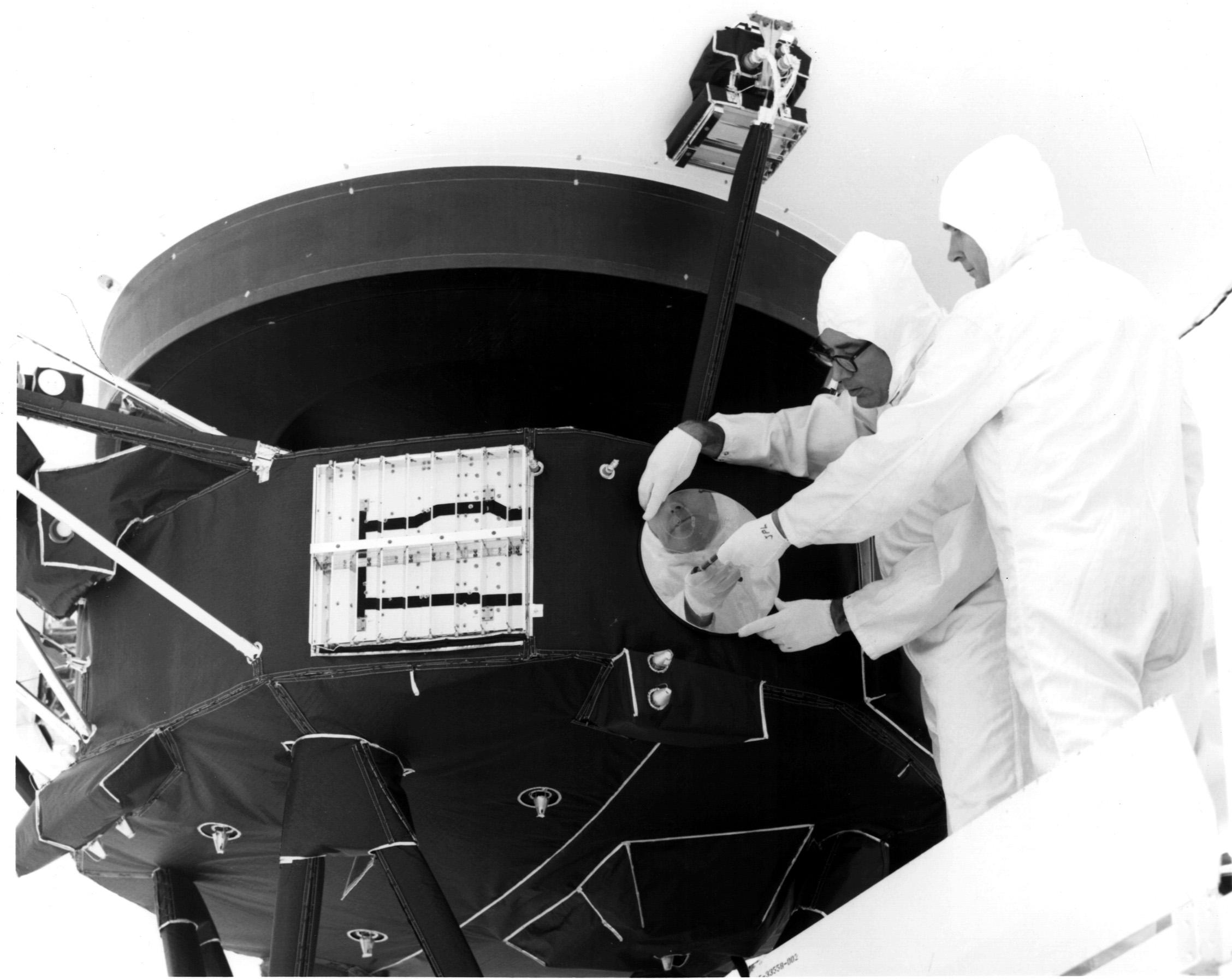
Voyager 1 launched from Cape Canaveral on 5 September 1977, atop a Titan IIIE-Centaur rocket, on a mission originally designed to last just five years and survey two planets. Nearly fifty years on, it is the most distant human-made object ever built, having flown past Jupiter (March 1979) and Saturn (November 1980), crossed the heliopause into interstellar space in August 2012, and continued sending data back across a solar system it long ago left behind. On 18 November 2026, Voyager 1 crosses an extraordinary new threshold: one light-day from Earth, roughly 25.9 billion kilometres, meaning it now takes light itself, and therefore Voyager’s radio signals, a full 24 hours to make the journey home.
Dr Garry Hunt was there from the very start. He was the only UK-resident scientist selected by NASA for the Voyager mission, working alongside luminaries including Carl Sagan, Brad Smith, Ed Danielson and Larry Soderblom as one of the nine members of the Voyager Imaging Team responsible for the spacecraft’s cameras and the iconic images they returned. For over a decade, Garry balanced his day job at the UK Met Office with regular trips to NASA’s Jet Propulsion Laboratory in Los Angeles, helping select and operate the vidicon camera systems that captured humanity’s first close-up views of Jupiter, Saturn, Uranus and Neptune and their moons.
Garry was also present for one of the mission’s most poignant achievements: the Pale Blue Dot image. As Voyager 1’s planetary encounters wound down and funding was set to end, the imaging team — including Garry — pushed to use the spacecraft’s cameras one last time before shutdown, turning them back toward the inner solar system to capture a “family portrait” of the planets, including Earth as a tiny point of light 6 billion kilometres away. It was, in Garry’s own words, the team’s determination “to do one big thing; really spectacular, before we turn it off”.
About the Event
To mark Voyager 1’s arrival at the one light-day milestone, the British Interplanetary Society is delighted to welcome Dr Garry Hunt OBE, PhD, DSc, FRAS, FIMA, FRMetS, FIoD for a special in-person evening lecture at BIS HQ. Drawing on more than fifty years at the frontier of planetary science, atmospheric physics and space broadcasting, Garry will take the audience back to the earliest days of Voyager’s planning, share first-hand recollections from mission control during the outer planet encounters and the Pale Blue Dot campaign, and reflect on what it means for a human-made object to now sit a full light-day from the world that built it.
Join us in person at Arthur C. Clarke House or online to celebrate this remarkable milestone with someone who was there from the very beginning.
About the Speaker
 Dr Garry Hunt has enjoyed a career spanning more than fifty years across science and business. A graduate of the University of London (1st Class Honours in Mathematics, 1964; PhD in Mathematical Physics, 1966), he joined NASA’s Jet Propulsion Laboratory in 1970 and became the only UK-resident scientist selected for the Voyager mission at its outset. His Voyager work, alongside investigations on Mariner 9, Viking, Nimbus 5, ERBE and IUE, underpinned major research groups at the Met Office, UCL and Imperial College, where he became Head of Atmospheric Physics and Director of the Centre for Remote Sensing.
Garry was awarded a DSc by UCL in 1981 for his research into atmospheric and planetary physics and climate change, and has published more than 350 scientific papers and 10 books. He has held professorships in atmospheric physics, meteorology, astronomy, business studies and information technology in the UK and US, served as President of IAU Commission 16 (The Planets), and received NASA Science Achievement Awards for Voyager imaging at Jupiter, Saturn, Uranus and Neptune.
Beyond academia, Garry has been CEO and executive director of major companies including Logica and ICL, and has advised organisations from EDS and HP to national governments. A broadcaster for over six decades, he was a regular contributor to The Sky at Night for nearly forty years and covered the Voyager and Space Shuttle era for ITN. He was awarded the OBE in the 2023 King’s Birthday Honours for services to Space Science and Business.
Featured image: Voyager-1, placing of the Golden Record, 1977. NASA/JPL-Caltech.