
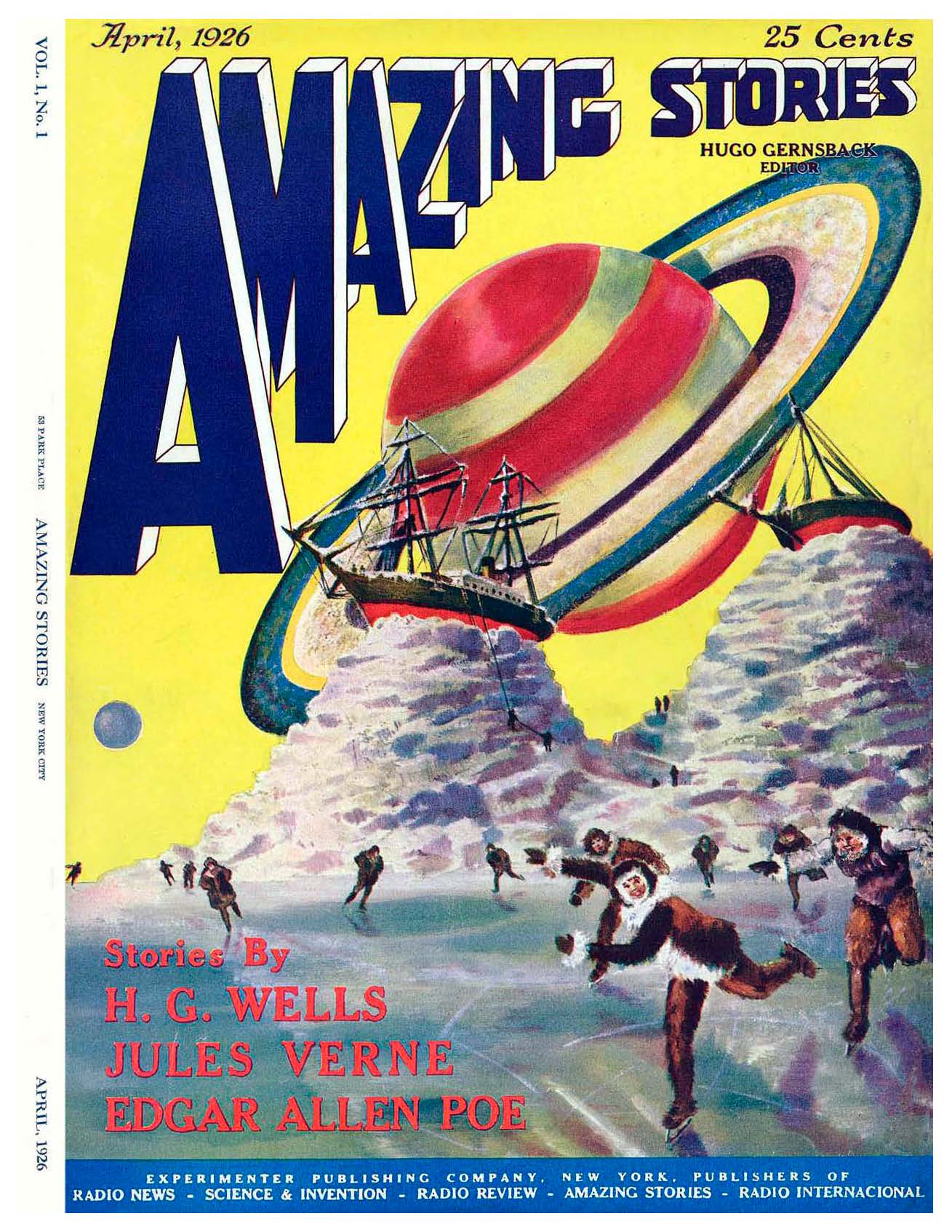
 On 1 April 1926, a slim new pulp magazine arrived on American newsstands with a bold promise on its cover: Amazing Stories would offer a “new sort of magazine”, devoted entirely to what its founder Hugo Gernsback called “scientifiction”. Until then, such tales were scattered through general fiction and popular science journals; now, for the first time, readers held a magazine dedicated solely to imaginative stories built around science and technology.
In his opening editorial, Gernsback argued that these “amazing tales” were not only entertaining but “always instructive”, using fiction to explore scientific ideas, future technologies and journeys beyond Earth. The first issue mixed reprints by Jules Verne and H. G. Wells with newer stories of Martian attackers, invisible men and strange beings from beyond known science, all illustrated by Frank R. Paul’s blazing visions of other worlds. That heady blend of speculation and science would define modern science fiction – and help inspire a generation who would turn dreams of spaceflight into engineering projects.
Across the Atlantic, those magazines – Amazing Stories among them – became a vital point of contact for early British enthusiasts. Letters pages, fan columns and postal addresses in the pulps allowed young readers to find one another, trade ideas and, eventually, organise. When Philip E. Cleator founded the British Interplanetary Society in Liverpool in 1933, it was the first national organisation to bring together UK science fiction fans and would-be rocketeers in significant numbers, channelling that culture of “scientifiction” into practical astronautics.
The BIS’s pre-war story is steeped in this crossover world. By the late 1930s, Arthur C. Clarke, William F. Temple and Maurice K. Hanson were sharing a flat at 88 Gray’s Inn Road, which, for a time, served as a joint address for both the BIS and the UK’s Science Fiction Association. Clarke would later chair the Society and help shape its post-war vision, while also writing the fiction that brought interplanetary travel to millions of readers. The route from the pages of Amazing Stories to serious technical papers in the Journal of the British Interplanetary Society (JBIS) runs straight through that small, enthusiastic community of readers, fans and experimenters.
A century after Gernsback announced his “new kind of fiction magazine”, the BIS still occupies that frontier between imagination and reality. Our publications range from the technical depth of JBIS to the mission coverage of Spaceflight and the historical perspectives of Space Chronicle. Alongside them sits Odyssey, the Society’s electronic science fiction, space art and culture magazine, explicitly dedicated to the imaginative side of space under the banner “From Imagination to Reality”.
As we mark 100 years since Amazing Stories first appeared, it is worth remembering that all space exploration begins in the human imagination. The pulps may have been printed on cheap paper and dismissed by many as “trash”, but for the BIS’s founding generation they were also a network, a classroom and a launch pad. A century on, the Society continues that tradition – turning amazing stories into real missions, and ensuring that the next generation of readers, dreamers and engineers can still find each other and look outward together.
Download this first issue by clicking the front cover image above.
This download is a Creative Commons Public Domain Mark 1.0.