
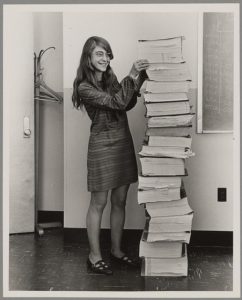
Image by courtesy MIT Museum. Margaret Hamilton at MIT in 1969, standing beside printed listings of the Apollo onboard flight software developed by the lunar module and command module teams she led.
The British Interplanetary Society remembers Margaret Hamilton, whose leadership in developing Apollo’s onboard flight software helped make humanity’s first journeys to the Moon possible. She died on 30 September 2026, aged 90; her death was announced by MIT on 7 October.
Before the Second World War, a technical core of BIS members was already studying how a rocket might carry people to the Moon and return them to Earth. Hamilton’s contribution to Apollo, three decades later, illuminates another essential part of that wider history, the painstaking work of making a spacecraft respond safely when events do not unfold as expected. Her legacy offers the Society more than a remarkable episode in space history. It invites us to look beyond the most visible achievements of exploration, and to recognise the systems, judgement and teamwork that make them possible.
Anticipating the unexpected
Hamilton began her computing career at MIT in 1959, working on weather-prediction software with meteorologist Edward Lorenz – research that later informed his celebrated work on chaos theory. At MIT Lincoln Laboratory she wrote software for the SAGE air-defence system, where she first became interested in software reliability, then a largely unexplored concept.
In 1965 she joined MIT’s Instrumentation Laboratory, which held the NASA contract to build Apollo’s onboard flight software, and was hired as the first programmer for the Apollo project at MIT. She went on to lead the teams developing the software for the lunar module and the command and service module; by 1968 more than 400 people were working on Apollo’s software, and Hamilton was assistant director in charge of the command and service module group.
The approach she championed was distinctive. Rather than assuming perfect hardware and perfect operators, build software that anticipates mistakes. When her four-year-old daughter, Lauren, crashed a command-module simulator by launching the wrong program during a simulated flight, Hamilton proposed a fix. When it was initially overruled on the grounds that trained astronauts would not make such an error, Apollo 8’s Jim Lovell did precisely that in flight, wiping the spacecraft’s navigational data. Hamilton’s changes were subsequently integrated into the program.
That philosophy proved its worth during Apollo 11’s descent in July 1969. Minutes before the Eagle was due to land, the guidance computer became overloaded and issued a 1202 program alarm. The software’s priority-driven design shed low-priority background tasks and kept the essential landing functions alive. Mission Control trusted the software and authorised the descent to continue, and Armstrong and Aldrin landed safely and into the history books.
Naming a discipline
Hamilton described her mission as giving software “legitimacy so that it — and those building it — would be given its due respect”. To that end, she championed the term “software engineering”, helping establish software as a discipline deserving of the same rigour as the hardware it served. She authored more than 130 publications, co-founded Higher Order Software in 1976, and later Hamilton Technologies, continuing to pursue systems designed to prevent rather than merely recover from error.
In 2016, President Barack Obama awarded her the Presidential Medal of Freedom, citing software that “helped America set foot on the moon”. In 2017, she became a Lego minifigure in the Women of NASA set – a small measure of what she had become to generations of scientists and engineers, and particularly to women entering technical professions.
Reflecting on the Apollo years, Hamilton told MIT News in 2009: “Looking back, we were the luckiest people in the world; there was no choice but to be pioneers.”
For the BIS, Hamilton’s legacy invites a fuller understanding of astronautics: one that recognises software alongside rockets, explains why reliability must be engineered, and celebrates leadership without overlooking teamwork. Her story reminds us that imagining a journey and making it dependable are different achievements, and that exploration requires both.
Ad Astra Margaret Hamilton, RIP