


Overlapping creative wavelengths: J.R.R. Tolkien and C.S. Lewis
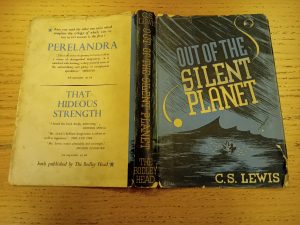
Out of the Silent Planet
Unlike the fictional planet in C.S. Lewis’ novel, the Earth has seldom been silent, at least not since the advent of the telecommunications era; we have been broadcasting into space for decades now, on a largely indiscriminate basis, with the volume dial set to overload. This outpouring across all bands in the electromagnetic spectrum was memorably depicted in the opening to the film adaptation of Carl Sagan’s novel Contact, as the Earth’s ceaseless radio chatter surges out, seemingly to the edge of the galaxy.
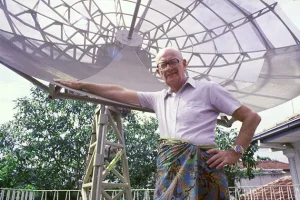
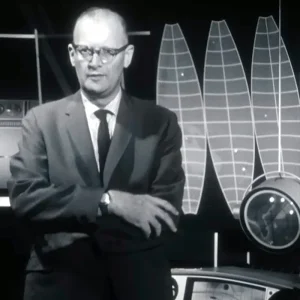
Arthur C. Clarke did much to herald the onset of the telecommunications age with his seminal paper in Wireless World (published in 1945) about geosynchronous satellites. So a little of the blame for our noisy world can fairly be laid at his door, though I suspect it’s a charge that wouldn’t have bothered him in the least; indeed, he’d have worn it as a badge of honour and rightly so. The title of that famous monograph — “Extra-Terrestrial Relays: Can Rocket Stations Give World-wide Radio Coverage?” — now sounds faintly anachronistic, like the title of a story that might have appeared in one of Arthur’s beloved science fiction magazines from the 1950s. But that was always the thing that made Arthur such an intriguing character — his ability to blend fact and fiction, to straddle the worlds of science and science fiction with such effortless ease.
And it was Clarke who teamed-up with his friend the rocket engineer Val Cleaver to take on both C.S. Lewis and J.R.R. Tolkien in a famous debate on the merits of space exploration held at the Eastgate tavern in Oxford in the late 1940s. The outcome was an honourable draw, with Lewis commenting as a parting shot: “I’m sure you’re very wicked people — but how dull it would be if everyone was good!”
In his collection of essays — Greetings, Carbon-Based Bipeds! — Clarke described Out of the Silent Planet as one of the first truly literary works in the emerging genre of science fiction (even if he disagreed with the author’s negative views about the consequences of humans venturing into space). It belongs in the same canon of stories as H.G. Wells’ The First Men in the Moon, scientific romances that predate the interplanetary probes that revealed the truth about many of our celestial neighbours (removing at a stroke the idea that they might harbour life). There’s nothing wrong with such a tradition of course and such works have the merit of harking back to an age when our world was a quieter place to be, the Earth a more silent planet than it is now, and none the worse for that.
A first edition copy of Out of the Silent Planet now resides in the library at the BIS, part of the Society’s Arthur C. Clarke archives, the book itself a stepping stone into space, as all good works of speculative fiction surely are. And it’s tempting to think that Arthur is still in that Oxford tavern, debating the merits of space exploration in the company of other men who knew a thing or two about literary stepping stones.
Mark Stewart
Editor of Odyssey Magazine
For more on Arthur C. Clarke and Val Cleaver see: https://www.bis-space.com/friends-to-the-end/
Suggested further reading:
A Scientific Romance by Roland Wright
By Space Possessed by Arthur C. Clarke
Billion Year Spree by Brian Aldiss
Contact by Carl Sagan