
(Image credit: NASA)
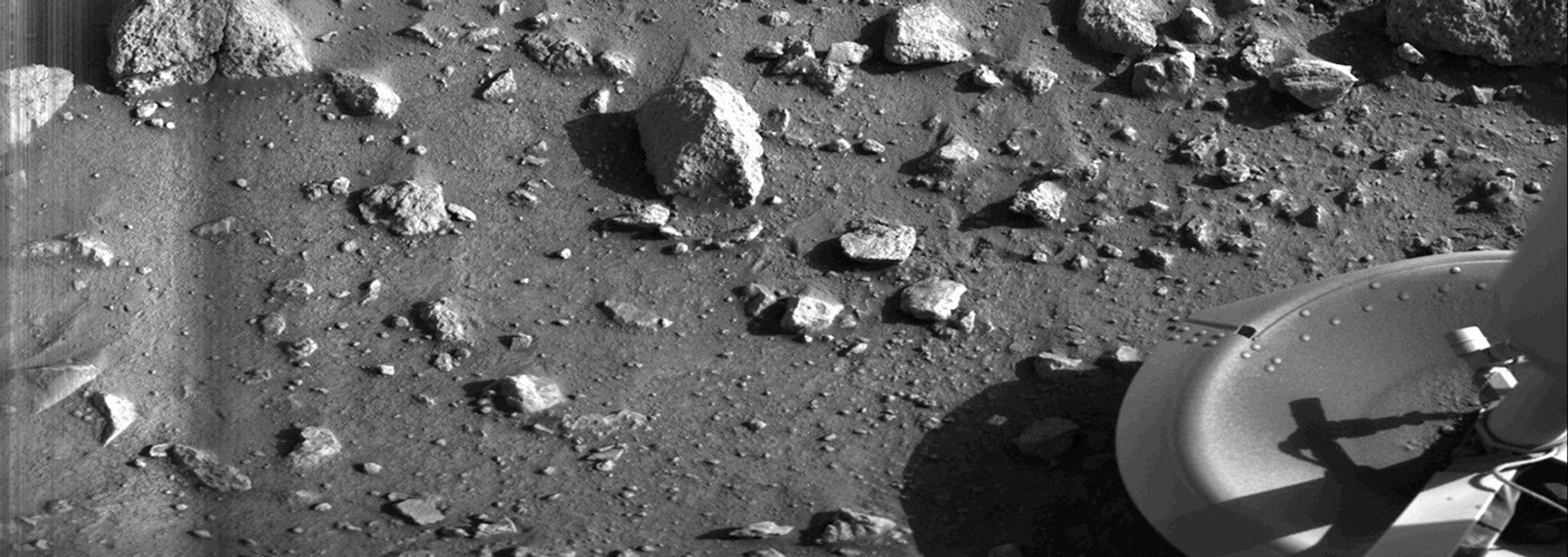
Fifty years ago this week, humanity’s exploration of Mars entered a new era. On 20 July 1976, NASA’s Viking 1 lander touched down on the western slopes of Chryse Planitia — Mars’ “Golden Plain” — becoming the first spacecraft to achieve a fully successful landing on the Red Planet and transmit images from its surface back to Earth.
Viking 1 launched from Cape Canaveral on 20 August 1975 atop a Titan IIIE-Centaur rocket, entering Mars orbit on 19 June 1976 after a journey of nearly a year. The lander separated from its orbiter companion and descended to the surface, where it began returning the first high-resolution, colour images of the Martian landscape — a moment that reshaped public and scientific imagination about our planetary neighbour.
The mission’s scientific ambitions went far beyond photography. Viking 1’s lander carried a suite of instruments including a Gas Chromatograph Mass Spectrometer, a seismometer, an X-ray fluorescence spectrometer, and — most famously — a dedicated biological laboratory designed to search for signs of life in Martian soil. On 28 July 1976, the lander’s robotic arm scooped the first soil samples ever analysed on another planet. The results were tantalisingly ambiguous: while some biological experiments returned weak positive signals, the gas chromatograph found no organic compounds, leaving the question of life on Mars unresolved to this day.
Meanwhile, the orbiter continued mapping the planet, eventually returning over 52,000 images and charting roughly 97% of the Martian surface at 300-metre resolution — a dataset that underpinned decades of subsequent Mars research. The orbiter operated until August 1980, when it exhausted its attitude-control propellant, while the lander — renamed the Thomas Mutch Memorial Station in 1982 in honour of the Viking imaging team’s leader — kept transmitting weather data until a faulty command ended communications on 11 November 1982.
Viking 1’s legacy is difficult to overstate. It proved that a soft, controlled landing on Mars was achievable, established the engineering and scientific playbook that every subsequent Mars lander and rover — from Pathfinder to Curiosity and Perseverance — has built upon, and opened the debate about Martian biosignatures that continues to drive mission design today.
This landmark anniversary is the subject of an extended feature in the July 2026 issue of Space Chronicle, the British Interplanetary Society’s flagship space history magazine, which looks back at Viking 1’s design, its dramatic descent, and its lasting influence on the search for life beyond Earth. Members can find the full feature in this month’s issue, alongside reflections on what the mission’s findings still mean for Mars exploration strategy 50 years on.
The British Interplanetary Society will continue marking this milestone through the coming months as part of its ongoing coverage of Mars exploration history and the missions that followed in Viking’s footsteps.